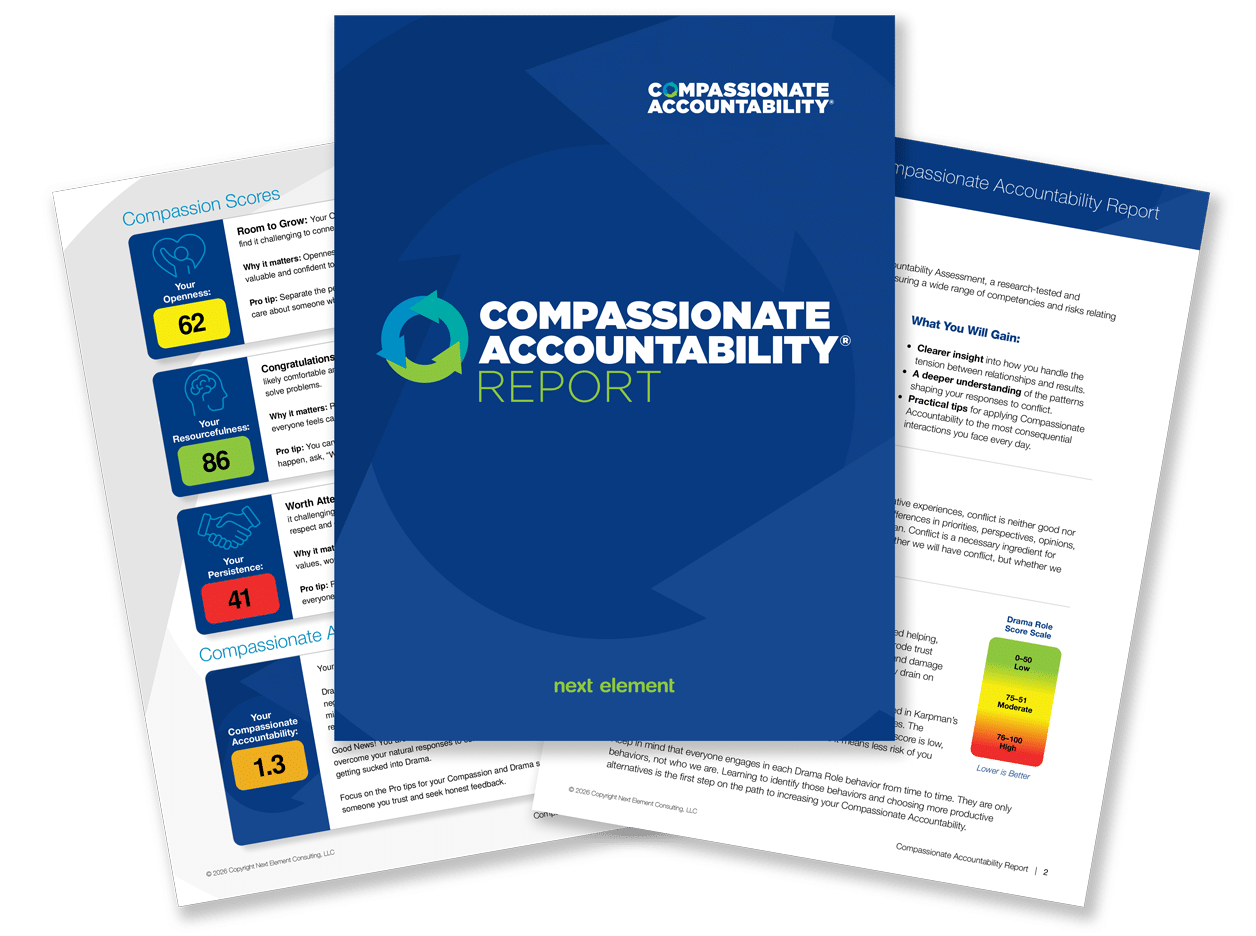
Now there’s a score for the hardest part of your job. The people part.

The Compassionate Accountability® Assessment measures what you actually do when you need a result from someone and you can’t afford to damage the relationship. Not one kind of interaction. All of them.

Get Your Score – $25 →

Your results come to you. Nobody else sees them unless you share them.

  • Pay $25 USD. One time, no subscription.
  • Answer 27 questions. Five to ten minutes.
  • Your report arrives immediately.

You handled it and two weeks later, it’s happening again.

Same person, same tension, and you still can’t name the thing you keep doing that keeps it going. The assessment measures six behaviors that decide how those moments go. Your report tells you which ones you lean on, which ones you skip, and what to practice.


Three that build capability.

Each one creates something a team can feel.

Openness

Saying how something is actually hitting you, and making it safe for the other person to do the same. Without it, people go quiet and stop telling you things.

Resourcefulness

Staying curious instead of locked onto your own answer, so you can use what other people know and what has already worked. Without it, you keep doing it the way you have always done it.

Persistence

Being clear about what matters, following through, and owning it when you’re the one who dropped the ball. Without it, what people agree to doesn’t happen.

Three that drain it.

Ordinary instincts, fine in small doses, that take over when the capability above them runs out. Each one sits under the capability it replaces.

Over-adapting

Keeping the peace by not saying the thing, until nobody knows where you stand.

Over-helping

Solving it yourself because that’s faster than one more round. It tells people not to bother trying.

Over-powering

Pushing harder when you meet resistance. It wins the moment and costs the next one.

Everybody does all six.

Your score is the balance between them.


You already know your type.

You know your style. You know your preferences. None of it tells you what you actually do when it counts. That’s what this measures, and it’s the part that can change.

The Compassionate Accountability Report

Your Compassionate Accountability Score is your baseline — where you stand today, on the same scale as everyone else who has taken the assessment. It’s not a personality test and it’s not a style profile. It measures what you do, so the number moves when your behavior does.

What’s inside

One number up front, and the six behaviors behind it. Here’s what you get:

  • Where you land on all six, color-coded, with a plain sentence on what each score means
  • Why it matters, for each of the six — how you use it and the potential consequences when you overdo it or skip it.
  • One tip for each, specific enough to use this week. Not general advice about communicating better.
  • A last page that asks you to pick one skill to build, one habit to ease off, and one thing you’ll try this week

$25 USD. One time, no subscription.

If the report doesn’t tell you something useful, let us know and we’ll refund your money.

The reports highlighted some of my more extreme tendencies. I already knew these were areas I needed to develop, but I had not previously been able to identify or articulate them so clearly.

Report user – Verbatim from pilot feedback, collected anonymously


Right now, you’re going on memory.

After a hard interaction, all you have is how it felt, which is why you replay it.

A score gives you something specific instead

None of this makes the next difficult interaction easier. It makes it something you can prepare for.

You know what you’re likely to do

before you walk in, instead of finding out afterward.

Words for what happened

clear enough to say out loud to the person involved.

The thing itself

getting the result you need without wrecking the relationship.

0%

of clients rate our method as superior to anything else they have used

0%

improvement in teamwork

0%

improvement in leadership skills

Used Inside


How the assessment was tested.

Independently validated by Thought Leadership Leverage, against the Society for Industrial and Organizational Psychology’s Principles for the Validation and Use of Personnel Selection Procedures and the federal Uniform Guidelines on Employee Selection Procedures.

Twenty-seven items, resolving to six confirmed factors. The full technical report is published if you want the methodology.

Read the technical report

On the framework the assessment measures

“Compassionate Accountability is the leadership standard of the future.”

Dr. Marshall Goldsmith
Thinkers50 #1 Executive Coach

“I am inspired by the alignment between the core principles of Trust and Inspire Leadership and Compassionate Accountability.”

Stephen M.R. Covey

Author, The Speed of Trust and Trust and Inspire

“You can’t have a healthy organization without healthy accountability. That’s Compassionate Accountability.”

David Horsager

Author, Trust Matters More Than Ever


Frequently Asked Questions (FAQs)


When one person’s score isn’t the question.

The Team Report isn’t a bigger version of this one. It answers a different question: how a team handles tension together, where it’s strongest, where it struggles most, and the one change that would make the biggest difference.

Tell us about your team

We’ll show you what the report would surface for a team like yours.


Organizations measure engagement, turnover, and safety.

None of them measures whether people can get the result and keep the relationship.

Five to ten minutes from now, you'll have that number for yourself.

One-time payment, no subscription. Your results come to you and nobody else sees them.