
How One Manufacturing Company Changed Conflict at Work and at Home
Share viaConflict in the workplace is inevitable. The difference is whether people have the tools to handle it productively.
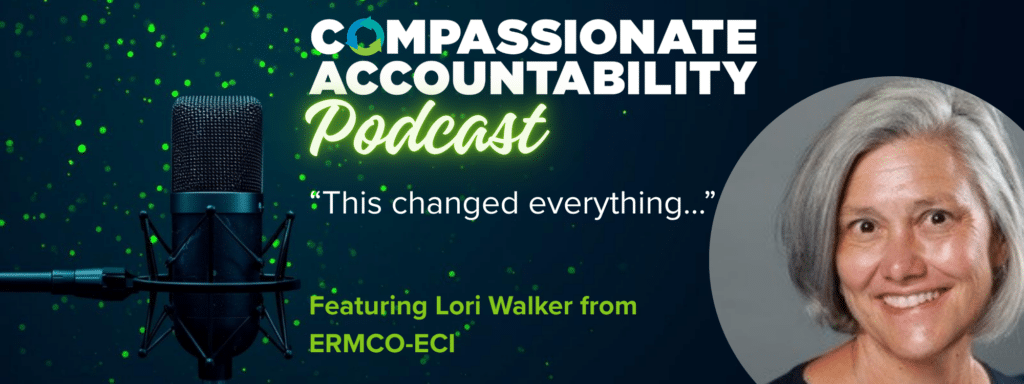
In Episode 65 of The Compassionate Accountability® Podcast, Dr. Nate Regier sits down with Lori Walker, Senior Manager of Talent Development at ERMCO, to explore how one manufacturing company is transforming leadership, communication, and accountability from the inside out.
Like many organizations, ERMCO faced a familiar challenge. Some leaders focused heavily on results but struggled with communication and conflict. Others prioritized relationships but avoided difficult conversations altogether. The result? Tension, inconsistency, unresolved issues, and missed opportunities for growth.
Rather than treating communication as a “soft skill,” ERMCO made a bold decision: build Compassionate Accountability into the foundation of leadership development across the organization.
In this episode, Lori shares how the company is scaling these tools across 3,400 employees, from executive leadership to the manufacturing floor, creating a culture where people feel heard, trusted, and responsible for results.
The most surprising part?
Employees didn’t just start using these tools at work. They started using them at home too.
This conversation explores:
- Why conflict avoidance quietly damages culture and performance
- How psychological safety fuels innovation
- What compassionate accountability looks like in manufacturing
- Why leaders need practical tools, not just good intentions
- How trust and ownership work together
- What happens when organizations truly invest in people
If you’re leading culture change, building leadership programs, or trying to create healthier accountability in your organization, this episode offers a practical and deeply human example of what’s possible when compassion and accountability work together.
🎧 Listen to Episode 65 now.
Watch the video
Listen to the audio
Read the transcript
Nate Regier: Welcome to the Compassionate Accountability® Podcast. I’m Nate Regier, and this is where we explore what it really means to lead with both compassion and accountability without separating the two through the real journeys of leaders who have lived it. If you’re navigating people, pressure, conflict, drama, and accountability challenges, you’re in the right place
When the president and CEO of a large manufacturing organization has a bold vision to transform the culture to become a regional employer of choice, where do you start? First thing you do is find the right people to create and lead the strategy. So today, I am fortunate to be joined by the person who is leading the charge to build compassionate accountability into the DNA of ERMCO’s culture, from design to implementation to sustainment, all supporting their core values.
Lori Walker is Senior Manager of Talent Development at ERMCO, where she leads enterprise-wide learning and development initiatives across multiple locations. She specializes in building scalable training programs, leadership development, and workforce planning that all align with business strategy. Lori is passionate about creating accessible, practical learning experiences that help leaders and teams grow, perform, and adapt in a rapidly changing environment. In our conversation, Lori shares a ton of strategies, best practices, and lessons learned that will apply to any organization that wants to build a truly remarkable leadership culture.
So Lori, welcome to the Compassionate Accountability Podcast.
Lori Walker: Thank you. Great to be here.
Nate Regier: I am so glad to have you here, and I’m so looking forward to this conversation. Before we dive into some of the nitty-gritty of what you’re doing at ERMCO, will you tell us a little bit about who you are and what you do?
Lori Walker: Sure. I am a senior training manager at a manufacturing company. I have a variety of different educational and training experiences in my background. I was lucky enough to join the company because they really value learning, and they value developing employees. So they decided to increase the level of training that they had at ERMCO. So, I joined and was able to help build a team to support all the great initiatives that we have going on here at ERMCO.
A little bit about what my day-to-day looks like. I have a manufacturing side of training, where we’re working to train the people on the manufacturing floor how to do their jobs better. We also have a professional group side, all the support people who help those production workers make more transformers. That’s what ERMCO is in the business of doing. And so we work on a variety of different projects, really helping to modernize the training and development for all employees at ERMCO.
Nate Regier: Wow. And you mentioned transformers. Will you tell us a little bit about what you all build and what it does in our country here?
Lori Walker: Sure. So, we build electrical transformers. Our motto is, “Our family powering your family.” And we are in the business of making sure that the transformers take the electricity from the big substations down to whatever is the end facility, so be that a house, a hospital, et cetera. There are actually a variety of different transformers throughout the United States. Every one is a bit different. They’re not 100% customized. So we do customize the transformers based on the client request. Some big times of year for us are storm season.
Nate Regier: Ah.
Lori Walker: So you can imagine when there are storms and transformers blow and lines go down, then those all need to be replaced. We really pride ourselves on making sure that we can keep our infrastructure up and running and provide those valuable resources to the entities as they need them.
Nate Regier: It’s amazing. We take these things for granted, but when lightning strikes or the storm comes and we’re out of power, all of a sudden we realize how important that is. And ever since I was at your facility in where you’re doing a lot of your innovation and creating some new stuff and seeing some of the things you’re doing for EVs and at gas stations, it just blows my mind what you do with electricity.
One of the unique things that we come to realize is that we know we do a lot of work in manufacturing and that manufacturing tends to not always be thinking a lot about people skills. We do a lot of technical training, but not so much people training, and that’s a new thing.
So, I’m curious, as you’ve gotten into this with ERMCO, what is one people-related challenge that you all face at work that maybe most people don’t appreciate?
Lori Walker: Not everything is done the same way. People are different, and they have their own way of working, and so try to really value the people side of getting something done. In the manufacturing industry, it is very task driven. You have deadlines and production quotas that you need to make. But you can also ask the person doing the work what their idea is to improve the process, what is their idea to make it better, and really get that ownership to it. And we have got some of the best ideas from asking our employees how would you solve this problem? What is another way that we could approach it?” So I think that’s very valuable.
Nate Regier: That’s a big change from traditional command and control leadership of the old days. So before getting involved, we’ve been working together for maybe a year and a half now, and even longer. We were working with your executive team before we really started more of an enterprise engagement. But, if you were to go and talk about what were things like before, what were some of the things you were struggling with and problems that you were trying to solve?
Lori Walker: ERMCO was a very people-centered organization. They really pride themselves and recognize the value of our people as our biggest asset. But one of the areas that we struggled with the most is finding that balance between honoring the person but also getting the work done. And so we found that people had a tendency to lean towards one side or the other. Either they were very focused on results, and that may have come across harshly, or they were very focused on the people, and they didn’t get the results that they were looking for.
So, our CEO had an opportunity to attend a conference where you were speaking, and this idea of Compassionate Accountability really spoke to him. He is very much, our people are our greatest asset, so how do I find that balance between the two? And so very early into my career with ERMCO, I had a chance to speak with Tim Mills, our CEO, about that idea. His challenge to me was, “I want a leadership program where our leaders hold people accountable, but do it in a way where it still honors the person.” And so after hearing him talk about the program and how invested he was, and the fact that you’ve had a chance to talk to some of our ELT members, I thought, “Wow, that would be a really great way to begin a leadership program.”
Before I came to ERMCO, there was no established leadership program. It was a hit or miss here or there. People would go take conferences or individual sessions or read books. But nothing really set as the foundation, and nothing really grounded us in our values as a company. So I feel like that was the area that was lacking, and something that I was looking to find a solution for.
Nate Regier: There’s just a couple of significant things about that transition that I remember that I want to mention here in a little bit. But you mention this dilemma of kind of focus on the relationship or get the results, and that was a struggle, and it’s really hit-and-miss which one people would choose. There wasn’t a consistent way of dealing with that. How did conflict or drama manifest this tension or this inconsistency?
Lori Walker: It depends on which side of the pendulum the leader would swing. If they would lean more towards the results piece they might have areas of conflict and not know how to address it. They would come across very harshly, maybe not communicate in a way that was effective. So they just didn’t have the skills or the tools to be able to have a good conversation. Still saying, “Hey, this is where we are. These are the results that we need to achieve as a company. But what are your ideas? What can you bring to the table? How can we come up with an idea together and still state what’s important, about sticking to our goals?”
On the other side, we had leaders that just avoided it. They didn’t even have the conversation. They would move employees to different departments. They would try to find another job for them. They would just let it fester until they got upset, and then it turned into a big blow up and maybe even something that we needed to involve our HR department in. So again, it’s the same principle of they just didn’t have the tools of how I’m going to approach the people and the results. Where do I find that balance?
Nate Regier: I like the way you said it. It’s not that anybody had malicious intent. They just didn’t have the tools. And in a very people first culture, we had the opportunity of being in your Dyersburg plant and just experiencing the culture, the region, the geography, and just what it’s like when everybody knows everybody. You’re close and you see each other outside of work. It seems like in those situations, conflict often will either be avoided, or it goes underground because everybody wants to keep the peace until it doesn’t.
What are some of the costs did you see, were you seeing any systemic impact on any of your metrics or performance or anything because of this problem?
Lori Walker: You mentioned people having very close-knit relationships, so there would be times when production would suffer bebecause the leader wasn’t comfortable in having a difficult conversation with those employees, and again, the letting it fester too long. So there would be a dip of something that didn’t work exactly the way that they needed it to. And then just the overall impact besides just the slowing down piece is just the ability to develop a person, to be able to help them as a leader and a coach get to whatever level that they need to be at. And sometimes you really need to have some difficult conversations with your teammates in order to give them guidance and let them see a different perspective.
Nate Regier: Yeah. You and I might have different experiences and memories of what kind of shifted. I remember working with Tim and the executive leadership team for about a year, and he became very convicted that this was a framework that he really wanted to go system-wide. I think at the same time he was looking to build an actual, real learning and development function within ERMCO to make this formal instead of just hit and miss.
I remember a key moment, I don’t know if you’re aware of this, but he was just push and push, and it’s like, “We’re going to do this, we’re going to do this.” One day he said to me, “You know what? I have to practice what I preach. This can’t just be my idea.”
“This really has to be their idea. And as much as I love it, it’s going to be picked up by them if it works for them,” and he completely let go. And I was shocked, “Oh my gosh, this whole thing’s going to fall apart.” But it’s just what you’re saying. It’s “What ideas do you have? What do you think?” And I remember at that moment it was like he really was practicing what he preached about this has to be your thing.
I’m curious how you experienced starting to take ownership and started to build this and turn this into Compassionate Accountability into a foundation for your organization.
Lori Walker: Sure. So I mentioned that my challenge when joining the organization was to develop a leadership program. And I wanted to really ground the work in our values as a company, what the company truly believes in. So as I looked at different ways to get started, I really wanted to create this foundation. So as we started to develop the program, we developed the Compassionate Accountability foundation. That is the first piece of information that our leaders are going to go through. We’re going to ground them in what our values are, and then we’re going to talk to them about how you can handle difficult conversations, how you can react in a time of conflict, and give them those tools to get there. Tim was very adamant about this needs to be their way and the way that they go about it. So in creating that foundational work, we were doing that. We were really establishing, this is where our company is headed and where we’re going, and it’s going to be a prerequisite before you go onto any other leadership training
Nate Regier: Wow. You built a whole framework about how all the pieces fit together. At this point, how are you deploying the Compassion Accountability framework? What pieces do you have in place so far to serve those goals?
Lori Walker: We’ve started with our executive level leadership team. Then we would work on the next senior level leaders a lot with our professional group. We have had a chance to walk through the various tools with them, let them practice. Now we are working on the next layer of leadership. We’re evolving the folks that went through the Compassionate Accountability sessions originally, and we’re taking them to the next step, which is helping them figure out how you handle conflict. So, really talk about how do I address conflict, how do I show up, how do others show up, and then how do I work through that.
Nate Regier: And a little bit of drama. We got to learn about drama.
Lori Walker: We definitely have some drama in there. For sure. How do you avoid it? How do you get past it? And just how do you get out of it? Yeah so that’s a great piece. What else we’ve done is we are starting to roll that out to our entire company with an e-learning. And so this idea of three switches of really thinking about employees are valuable, capable, and responsible that feeds in very well with our power values. So the way I describe it to people is our power values is what we believe in, keeping our switches turned on is how we show people that we do that. So this e-learning is currently with our mid-level and higher-level leaders. They’re able to go through, either get re-grounded if they’ve already been through the training, or be exposed to it for the first time, what it means to have valuable, capable, and responsibility switches turned on.
Up next, we are going to give that same e-learning to our individual contributor level across the entire manufacturing organization, so that means the folks that work on the production floor. I feel very lucky to be associated with a company that values this idea so much that they’re willing to take people off the production floor for a period of time to go get this training and learning.
Nate Regier: That’s a big investment.
Lori Walker: It is. After our team members have had a chance to go through the e-learning, the next step is we are providing leaders with a few talking points of how they can go back and have conversations with their team members. “Okay, so you’ve taken this e-learning. What does it mean to you? How do you see that? How do you see it showing up?”
And then another thing our company is doing is developing a recognition program for people who exhibit the values that we’re looking for. We will be shortly on the heels of introducing that as well. So it’s really an entire program. “Here’s what we believe. Here’s how you show up to show that’s what you believe, and here’s how we’re going to recognize you for exhibiting those values.”
Nate Regier: Wow, you’re not just taking it to the training. You’re taking it to sustainment, to implementation, to practice, to really making it part of your DNA, your culture.
Lori Walker: Yes.
Nate Regier: That’s amazing.
Are there any milestones or points of progress you’ve reached where you look back and said, “Wow, we’ve really come somewhere. We have something to show for our efforts”?
Lori Walker: Yes. I have continued to do a variety of different leadership training with different groups. One of the groups that I recently worked with that had been through the program they talked about how they have used the tools that they have at their disposal now, how it’s easier to have those conversations. And so starting to really see the results of that because they are having more success with their individual conversations. Haven’t had a lot of time yet to see numeric responses, but definitely from a people standpoint, people are feeling more heard, more listened to, and more seen. So I definitely count that as a big success.
Nate Regier: That is a big success because you’re describing the factors of openness, which is one of the three Compassion Skills that we teach. And I was talking to Amy Edmondson recently and she said some of the new research that they’re doing now is really starting to solidify the connection between psychological safety and innovation. To the extent that your company wants to innovate and to continue coming up with good ideas, that openness is so important to cultivate, and it’s not something that I think manufacturing traditionally focuses on.
Lori Walker: Yes. And you have to establish that level of trust and make it a safe place to have conversations and to share those innovative ideas. If you don’t feel safe, you are going to hold that in and think, “Ugh, I’m not quite sure how my leader is going to handle this,” and good ideas get left on the table. So it’s great to establish that safe space to talk.
Nate Regier: Yes, I can’t remember if it was you or one of your colleagues that told me a story about when you started to introduce some of these concepts onto the shop floor into individual contributors. You were a little bit nervous about how this kind of traditional manufacturing environment is was going to take to soft skills, and you were pleasantly surprised.
Lori Walker: Yes. We were a bit nervous. There’s several folks that have just very matter of fact personalities. It’s black and white. We’re here to get this done and move forward. But when they saw that they could use this tool in their personal life as well as at work, I think that was the first area that they opened up to is, “Oh, you mean I can use this at home and have a conversation with my teenager that I’m struggling with, and help get through that?” And so when they had a chance to practice it and really try it out in their home life, that’s when we got them, and then they would come back and say, “Okay, that stuff really does work. So maybe if I tried it at work, it would work there as well.”
Nate Regier: That would be step number one to become an employer of choice. To actually help your people be more effective in all areas of their life.
Lori Walker: Yes.
Nate Regier: That’s a real value add on. Oh, that’s really neat.
Is there anything else you want to share? ‘Cause I think it’s really powerful you’re talking about connecting your value, core values with these tools. Is there anything else about how those connections work? Maybe a specific example about how Compassionate Accountability manifests or helps people live out any one of your core values.
Lori Walker: Sure. So, one of our core values is focused on ownership. And when you own something, that means you’re going to really take responsibility for the results, good or bad. And that’s one of the switches, responsibility, I think people can be responsible and walk through that. We have had a few leaders who own the program or own the thing that they’re working on, but they don’t want to give the work to their team members just from a lack of their own confidence. Another example or another way to say it is several of these leaders have been promoted to do a really good job. They’ve done the job before. And now they’re turning their baby over to someone else. And it’s hard to let that go and to truly give the ownership. But when we talk to them about, if you’re holding onto it, you are trying to be the hero and balance all the plates, and you just can’t possibly do that and be effective in your new role, and so what does that mean to be a leader versus the individual contributor? We know you did a great job with it and you can do it, but that’s not your role any longer.
Nate Regier: Yes.
Lori Walker: Now that is the other person’s role. And a couple of leaders that I work with are really our engineering group that’s very innovative have had that situation. And they’re being very open and talking to each other about how do we go about giving that ownership to the team members. They’ve had some good examples of walking through that with team members and just letting their ideas come through. Just because that’s the way they did it doesn’t mean that it always has to be done that way. And we’ve come up with some really innovative solutions by just letting go of their own ownership, keeping the responsibility switch turned on.
Nate Regier: I am all for anything to make our transformers better every day.
Lori Walker: Yes.
Nate Regier: So, whatever it takes. This is a multi-year plan that you’re making and that we’re supporting you with here. And I just wanted to emphasize, when you said rolling it out to everybody, how many employees are you going to touch eventually with just with the e-learning?
Lori Walker: 3,400 employees. And we’ll also continue to do this with new hires. It’s not just a one and done program. It really is going to be something that lives and breathes through the culture of ERMCO for years to come.
Nate Regier: Where do you have locations?
Lori Walker: We have sites in the state of Tennessee, Georgia, New Mexico, Canada and Wisconsin. So all over. We have new sites coming soon, more westward bound, so the company is looking to expand, and this program will expand there as well.
Nate Regier: Wow. That’s fantastic. I would love to keep asking you more questions about the nitty-gritty of what you’re doing, but just to step back, for anyone out there who’s listening that is coming into a similar position as you or trying to build a program that really integrates with the core values of the organization, or maybe they’ve been brought in like you to build something for the first time that hasn’t existed I’m going to ask you just a couple reflection questions about what you’ve learned. I’m curious, you’re in the business of leadership development, but what has this journey with Compassionate Accountability taught you about leadership?
Lori Walker: That you can be nice and a leader at the same time.
Nate Regier: That’s such a great message.
Lori Walker: Yes. And as a young leader, I’m not sure that message was always portrayed as well to me as it could have. As you continue to progress through your career, you really do start to see that nothing happens without people. And you really do need people to be your greatest asset to work through it, and it just makes it a more pleasurable place to work. When people can figure out how we can have good discussions, and sometimes discussions that we don’t agree with and still get past, it makes a big difference about your willingness and motivation to get up and go to work the next day.
Nate Regier: For sure. How do you approach conflict and communication differently now?
Lori Walker: I have tools. I have tools available to me to use. I’ve got this wonderful tool called ORPO, and I start with being open. I have an example just recently where I was talking to a person on my team, and I was like, “I am feeling this. I hope I could feel like that.”
“What do you think? How are you feeling?”
And it’s just an easier way to start the conversation instead of just tiptoeing around it and trying to avoid it.
Nate Regier: Yes. So many people have been trained to believe or have come to believe that talking about our feelings or opening up is somehow weak or vulnerable or inappropriate or crosses a boundary. But with the right tools, it really creates just a great level playing field of human equality to start solving the hard problems.
So what advice would you give to a leader facing a similar challenge that you had when you were hired to come in at ERMCO and start transforming this?
Lori Walker: I think the first thing that you need to determine before you develop any training program is what does the company believe in? What are their core values? What sets them apart from other people in the same industry, the same space? And really capitalize on taking those core values as the foundation of whatever you build. So, finding a program that fit very well with this people first attitude at ERMCO was really what I was looking for, and this program fit that very well. It really does focus on working through with people, valuing them where they are, and helping them get better.
Nate Regier: I’m curious, when it comes to conflict, what is something you used to believe but you don’t anymore?
Lori Walker: I used to believe that conflict was bad and to be avoided at all costs. Now I believe conflict is good. Only good things can come when old things are torn down. So how are you going to move forward if you don’t find that edge of where the difference is between comfort and a little bit scared? And conflict is usually where those two match.
Nate Regier: Oh, that’s cool.
What is one thing new you’ve learned about trust?
Lori Walker: I think I knew this, but something that’s just been reiterated is trust is a foundation. It really is required before you can move on to the next piece. And, one of the best ways to establish trust is just to show that you care about the person that you’re talking to, and that you value who they are and that you’re going to continue to work with them and help them get to the next piece. So without trust, it’s really hard to move on to any of the next steps.
Nate Regier: Last question.
What is a risk that you’ve taken on this journey that you were scared about, but it paid off?
Lori Walker: The whole program.
Starting something that’s about feelings and how you feel your way through things in a manufacturing environment. That was a bit of a risk. I definitely had the buy-in from executive level leaders, but as we talked before, when we get down to the folks that are really making things happen and getting transformers pushed out every day, sometimes they just don’t have the same approach. And so that was a bit scary, going in and saying, “Hey, we really are going to value what we mean by people are first, and here’s some tools on how you can show that you really do think people are valuable, capable, and responsible.”
Nate Regier: It is tremendous what you’ve done. And the level of depth and commitment to making it real at all levels is just really fantastic. Lori, thank you so much for what you’re doing and for who you are, and for your willingness to learn and grow through this whole process, and for coming on the show and sharing your journey.
Lori Walker: Thank you. I appreciate it. It was wonderful talking with you. I can’t wait to visit again in a few years and tell you our new level of results.
Nate Regier: Oh, yes. We’ll be there.
So I’m curious, is there anything else you want to say about your company? About ERMCO? Anything you want people to know out there?
Lori Walker: Just that ERMCO’s a great people first company. I have worked for a variety of different companies throughout my career, and this one really feels like home. And it feels like home bebecause people treat you that way. And they treat you like someone that they care about. So we’ve got great leadership with their eye on the future, but also considering where we are right now in the present. I just couldn’t be more thankful to be in a place that really helps me grow in my career and helps others do the same thing, which is a learning and development manager’s dream.
Nate Regier: Yes. I think it’s a fitting metaphor. We often talk about conflict as energy, and you can move it in positive ways which can build and grow and innovate, or you can move in negative ways that really can destroy cultures and relationships. Your company moves energy. It’s what you do for a living. You move electricity around the world and into places and make it usable for the end user. And now you’re also doing the same thing with conflict energy within your organization. You’ve got the corner on energy movement.
Lori Walker: Yes.
Nate Regier: Awesome.
Lori Walker: Yes, we’re plugged in.
Nate Regier: You are plugged in!
So, if anybody wants to learn more about you or get a hold of you, how could they connect with you?
Lori Walker: Sure. LinkedIn, I am available there. You could find my profile, and I would love to connect with you and see if you have any questions.
Nate Regier: Awesome. Lori, thanks again for coming. Really appreciate you.
Lori Walker: Thank you.
Nate Regier: You’ve just been listening to the Compassionate Accountability Podcast. I’m Nate Regier, and in this episode we learned how a manufacturing company started from scratch to begin focusing on people skills that truly make the difference, not only in business performance, but in building a culture that attracts and retains top talent.
If this episode resonated and you want to learn more about building a culture where compassion and accountability coexist, please subscribe on Apple Podcasts, Spotify, YouTube, or wherever you listen. And please rate, review, and share this podcast to help us reach more listeners. And if you’d like to learn more about Compassionate Accountability or connect with us directly, visit us at next-element.com.
Thanks for tuning in, and we’ll see you next time.
Copyright, Next Element Consulting, LLC 2026
Explore more of Compassionate Accountability® with our award winning book.
Book Your Next Keynote Speaker

Author and Co-founder of Next Element, Dr. Nate Regier is available to speak at your upcoming event.
Submit a Speaker RequestPodcast: Listen to Nate "On Compassion"
 Listen to the Podcast
0 Comments
Add comment