
Accountability without compassion gets you alienated
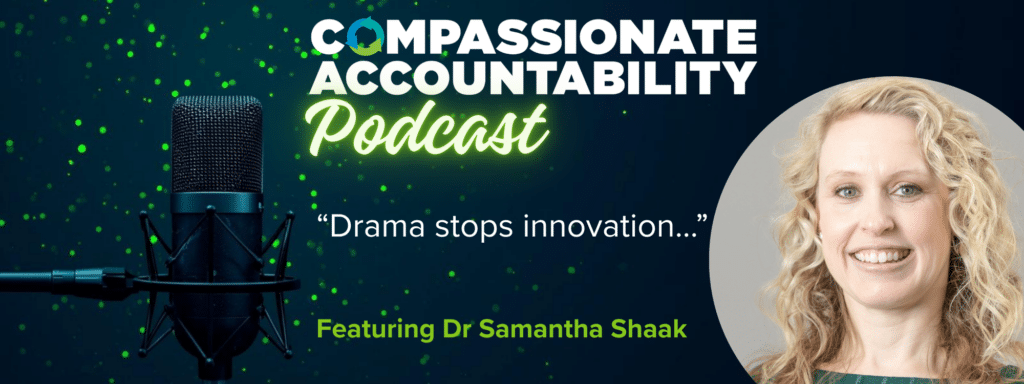
Share viaIn this episode of The Compassionate Accountability Podcast®, Dr. Nate Regier sits down with Dr. Samantha Shaak, Executive Director of the Leonard Parker Pool Institute for Health and Vice President of Community Health at Lehigh Valley Health Network, to explore what it really takes to develop leaders who can collaborate across sectors, navigate complexity, and create lasting impact in their communities.
Addressing challenges like housing, education, homelessness, addiction, and mental health requires more than passion and good intentions. It requires leaders who can build trust, communicate across differences, and stay connected when the work gets hard. Samantha shares how the Pool Fellowship for Health in Pennsylvania’s Lehigh Valley is equipping nonprofit, government, and community leaders with the self-awareness, communication skills, and conflict capacity needed to do exactly that.
In this episode you’ll learn:
- Why cross-sector leadership is essential for solving complex social issues
- How trust is built, weakened, and restored in collaborative work
- The role of self-awareness in leadership development
- Where miscommunication and drama show up in partnerships
- Why practical communication tools matter more than theory alone
- What it takes to build a locally grown leadership program that lasts
Rapid fire questions include:
- What is one truth about conflict?
- What is one thing leaders forget about communication?
- What is the most common “aha” you see from people in your program?
- What is the most important thing you’ve learned about yourself along this journey?
If you’re building a leadership program, investing in developing leaders, or trying to solve complex problems that no one organization can address alone, this episode offers a powerful example of what becomes possible when compassion and accountability work together.
Watch the video
Listen to the audio
Read the transcript
Nate Regier:
Hello and welcome to the Compassionate Accountability® Podcast. I’m Nate Regier, and this is where we explore what it really means to lead with both compassion and accountability—without separating the two—through the real journeys of leaders who have lived it.
If you’re navigating people, pressure, conflict, drama, or accountability, you’re in the right place.
This episode is packed with insight for developing leaders in organizations and communities. Addressing complex issues like housing, education, homelessness, and mental health requires a special kind of leadership.
Today, we’re exploring a standout leadership development program in the Lehigh Valley of Pennsylvania.
My guest is Dr. Samantha Shaak, Executive Director for the Leonard Parker Pool Institute for Health and Vice President of Community Health at Lehigh Valley Health Network. The Pool Institute brings together institutions and people to identify system-level changes that support the foundations of health.
Samantha, welcome.
Samantha Shaak:
Thank you so much. I’m really happy to be here.
Nate Regier:
Tell us a bit about yourself and your work.
Samantha Shaak:
I serve as Executive Director of the Leonard Parker Pool Institute for Health. We’re based in Allentown, Pennsylvania, about an hour and a half outside Philadelphia, and we’re part of a large healthcare system.
Our role is to improve community health beyond hospital walls. That means partnering with community organizations, local government, school districts, and healthcare providers to create collective, long-term solutions.
My background is in human development, family studies, and psychology. I come from a research and data perspective, focused on providing information that supports better decision-making. Over time, that led me to focus on leadership—particularly how we prepare leaders to work across sectors and collaborate effectively.
Nate Regier:
From your perspective, what’s a people-related challenge that often goes unnoticed?
Samantha Shaak:
One of the biggest challenges is balancing individual organizational goals while finding shared outcomes. We talk a lot about collaboration, but true collaboration—especially when it’s difficult—requires time, trust, and intention.
It’s easy when everything aligns. The real challenge is when things don’t go as planned. Do we create space for honest conversations? Do we invest enough in relationships to work through those challenges?
That level of collaboration takes commitment and organizational support.
Nate Regier:
Tell us more about your leadership program.
Samantha Shaak:
The Pool Institute acts as a convener rather than running direct programs. We take a holistic view of community development—making sure partners and initiatives are aligned and building toward something bigger.
A key part of that is the Pool Fellowship for Health. It’s a nine-month program for nonprofit and government leaders in the Lehigh Valley, focused on building the skills needed for cross-sector collaboration.
We’re developing layers of leadership locally—people who can think differently, work across boundaries, and address complex social issues in a more integrated way.
Nate Regier:
What problems is the program designed to solve?
Samantha Shaak:
Issues like poverty, homelessness, addiction, housing, and education don’t have simple solutions. No single organization can solve them alone.
The fellowship helps leaders shift their thinking—from working in isolation to working collectively.
It also creates a shared understanding. Without that, collaboration becomes much harder. This program builds a common language and approach across the community.
Nate Regier:
What challenges do you face?
Samantha Shaak:
People are always the biggest variable. Roles change, people move, and maintaining continuity is difficult.
There are also a lot of moving parts—bringing in experts, connecting different modules, and maintaining relationships across cohorts. As the network grows, we also need to ensure people stay connected over time.
Nate Regier:
Where does miscommunication show up?
Samantha Shaak:
Miscommunication is often at the root of collaboration challenges. When people misinterpret or don’t feel able to speak honestly, alignment becomes surface-level.
Over time, that erodes trust and prevents meaningful progress.
Nate Regier:
What makes trust fragile?
Samantha Shaak:
Trust takes time to build and can be undone quickly. Many collaborations begin with past experiences—sometimes negative—so trust doesn’t start at zero.
Every interaction either builds or weakens it. Without enough trust, even small moments can have a big impact.
Nate Regier:
Why bring in Compassionate Accountability tools?
Samantha Shaak:
We start with self-awareness—understanding who you are as a leader and how you communicate.
These tools help leaders recognise their communication styles and adapt to others. It’s not just awareness—it’s practical application.
Before effective collaboration can happen, leaders need to understand themselves and how they show up in conversations.
Nate Regier:
What results have you seen?
Samantha Shaak:
The biggest outcome is relationships. Leaders build strong, lasting connections and gain a network they can rely on.
We’ve also seen new partnerships form across sectors—addressing issues like mental health, housing, and addiction in more integrated ways.
Over time, the impact has grown from individual relationships to broader community collaboration.
Nate Regier:
What has this taught you about leadership?
Samantha Shaak:
Relationships are essential. Creating space for connection isn’t optional—it’s critical.
Diverse perspectives also matter. Bringing together different backgrounds and experiences strengthens outcomes.
And finally, leaders need practical tools they can apply every day—not just ideas, but actions.
Nate Regier:
Wow, there have been so many golden nuggets in this conversation so far. We’re going to wrap this up with four rapid fire questions. I’m going to ask a question, and you say the first thing that comes to mind. Are you ready? Here we go.
What is one truth about conflict?
Samantha Shaak:
It’s inevitable.
Nate Regier:
What do leaders forget about communication?
Samantha Shaak:
Their perspective isn’t the only one.
Nate Regier:
What’s the biggest insight participants gain?
Samantha Shaak:
It’s not about changing what you do—it’s understanding how it connects to a bigger system.
Nate Regier:
What have you learned personally?
Samantha Shaak:
To trust the process and the people. When you invest in relationships, things often unfold in ways you couldn’t have planned.
Nate Regier:
That’s awesome. Thank you. Before we end, is there anything else you would like to share?
Samantha Shaak:
I think the work we are doing is the coolest right now. Creating space for collaboration leads to innovation. Any community can do this work—and that’s what makes it powerful. We’re not doing anything that any other community can’t do, and I hope that more work like this happens all over the place.
Nate Regier:
That’s fantastic, I can feel your energy, and I can sense your passion. Where can people learn more?
Samantha Shaak:
Visit lpih.org, all the information about what we do, and the fellowship is on there, or connect with us on LinkedIn.
Nate Regier:
Well, Samantha, thank you so much for being here, sharing your precious time with us, and giving us some tips for this journey of creating leadership programs that really can impact on the community in a profound way.
Samantha Shaak:
Thank you, and thank you for your partnership in this and for helping to train our fellows here as well.
Nate Regier:
You’ve just been listening to the Compassionate Accountability Podcast. I’m Nate Regier, and in this episode, we experience the impact leaders can have in a community when they build on their strengths, work together, communicate with intention, and collaborate across differences. If this episode resonated and you want to learn more about building a culture where compassion and accountability coexist, please subscribe on Apple Podcasts, Spotify, YouTube, or wherever you listen.
You can also rate, review and share the podcast to help us reach more listeners. And if you’d like to learn more about Compassionate Accountability or connect with us directly, visit us at www.nextelement.com. Thanks for tuning in and we’ll see you next time.
Copyright, Next Element Consulting, LLC 2026
Explore more of Compassionate Accountability® with our award winning book.
Book Your Next Keynote Speaker
Author and Co-founder of Next Element, Dr. Nate Regier is available to speak at your upcoming event.
Submit a Speaker RequestPodcast: Listen to Nate "On Compassion"
 Listen to the Podcast
0 Comments
Add comment