

Basic Human Needs and the Path to Thriving
Share viaWhy Compassionate Accountability® Matters at Every Level
Human beings are wired with fundamental needs. From the most basic requirements for survival to the deeper longing for meaning and purpose, these needs shape our behavior, our relationships, and our capacity to thrive. Frameworks like Maslow’s hierarchy of needs have long helped us understand this progression, from physiological survival to self-actualization. Yet what often goes unexamined is how people move through these levels in healthy, sustainable ways.
This is where Compassionate Accountability becomes essential.
Thriving is not achieved by compassion alone, nor by accountability in isolation. It requires both, working together at every level of human need.
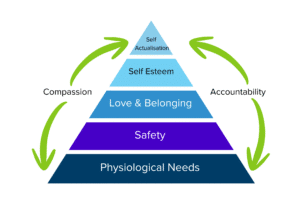
The Foundation: Survival and Safety
At the base of human needs are physiological essentials, food, water, rest, and health, followed closely by safety and stability. These needs may seem obvious, yet in practice they are often compromised by stress, burnout, economic pressure, or organizational cultures that overlook human limits.
Accountability plays a role even here. We are responsible for caring for our bodies, managing our energy, and making choices that sustain our well-being. At the same time, compassion is critical, both self-compassion and compassion for others. Not everyone has equal access to resources, capacity, or support. Judgment does not improve survival; understanding does.
In healthy systems, accountability ensures needs are addressed, while compassion recognizes context, barriers, and human vulnerability. Remove either one, and the foundation becomes unstable.
Safety and Connection: The Need to Belong
As basic survival becomes more secure, human focus shifts toward safety, trust, and connection. Belonging, to families, teams, organizations, and communities, is not a “soft” need; it is central to psychological health and performance.
Compassion is indispensable at this level. People need to feel seen, heard, and valued. They need environments where mistakes are met with curiosity rather than blame, and where differences do not threaten inclusion.
Yet compassion without accountability can erode trust. When expectations are unclear, boundaries are inconsistent, or responsibility is avoided in the name of being “nice,” relationships weaken. Accountability provides structure, clarity, and reliability, the very things that make connection safe.
True belonging emerges when people know they matter and know what is expected of them.
Esteem: Dignity, Confidence, and Contribution
Higher in the hierarchy sits the need for esteem, self-respect, confidence, and recognition for meaningful contribution. This is where accountability becomes increasingly visible.
Growth requires ownership. Skill-building, follow-through, and performance are not acts of pressure; they are acts of self-respect. Accountability invites people to step forward, take responsibility, and stretch beyond comfort.
At the same time, compassion ensures that accountability is not weaponized. People develop confidence when feedback is honest and humane, when challenges are paired with support, and when failure is treated as information rather than identity.
Esteem is not built through praise alone. It is built when people are trusted with responsibility and supported as they learn to carry it.
Self-Actualization: Becoming Fully Human
At the highest level of human need lies self-actualization, the drive to fulfill potential, pursue purpose, and live in alignment with values. This is the realm of thriving rather than merely surviving.
Reaching this level requires both deep compassion and rigorous accountability. Compassion keeps people connected to meaning, values, and humanity. Accountability turns intention into action. Without accountability, purpose remains abstract. Without compassion, achievement becomes hollow.
Self-actualization is not a solitary pursuit. It is sustained by relationships, environments, and cultures that encourage both care and responsibility.
Compassionate Accountability at Every Level
A common misconception is that compassion belongs at the lower levels of need, while accountability is reserved for the higher ones. In reality, both are required everywhere.
We are accountable for meeting our basic needs, and compassionate when support is required. We are compassionate in creating safety and belonging, and accountable for how we show up in relationships. We are accountable for growth and contribution, and compassionate when learning is difficult.
Thriving does not happen by climbing past compassion or outgrowing accountability. It happens by integrating them.
Compassionate Accountability is not a leadership technique or a performance strategy. It is a human necessity. Without it, people stall, individually and collectively. With it, they build the capacity to meet needs, grow with integrity, and live fully.
And that, ultimately, is what we are all striving for, not just to function, but to thrive.
Begin your journey in Compassionate Accountability® with our multi-award winning book.
Book Your Next Keynote Speaker

Author and Co-founder of Next Element, Dr. Nate Regier is available to speak at your upcoming event.
Submit a Speaker RequestListen to Nate on The Compassionate Accountability Podcast
 Listen to the Podcast
0 Comments
Add comment