

Using Compassionate Accountability® in High-Intensity Moments
Share viaPressure doesn’t change the principles of leadership. It reveals them.
In highly intense situations, layoffs, performance terminations, public mistakes, financial shortfalls, safety incidents, nothing about Compassionate Accountability® changes. We still rely on the Compassion Cycle. We still lead with openness, resourcefulness, and persistence.
But intensity amplifies emotion. And if we don’t understand how emotions work, they will quietly hijack everything.
Let’s start with the fundamentals.
Emotions Are Not the Enemy, But They Are Powerful
Emotions are biological signals. They are fast, automatic, and protective. When we perceive threat, whether physical, reputational, relational, or financial, the brain shifts into survival mode.
Blood flow prioritizes the limbic system.
Stress hormones increase.
The neocortex, the part responsible for reasoning, language, and complex decision-making, gets less oxygen.
That’s when fight, flight, freeze, or fawn takes over.
In high-intensity leadership moments, this matters. Because if we allow emotions to run unchecked:
- We become reactive instead of responsive.
- We default to blame or avoidance.
- We over-control or withdraw.
- We protect ego instead of protecting relationships.
Compassionate Accountability doesn’t remove emotion. It helps regulate it and leverage it.
Emotional Regulation Is the Gateway Skill
You cannot run the Compassion Cycle effectively if your nervous system is flooded.
Openness requires self-awareness.
Resourcefulness requires curiosity.
Persistence requires steadiness.
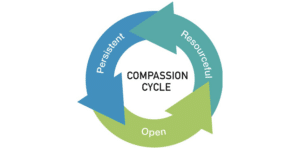
None of those are accessible when the brain is in threat mode.
A leader with low emotional regulation in a crisis might:
- Deliver hard news bluntly and defensively.
- Avoid eye contact or rush the conversation.
- Become rigid, overly factual, and cold.
- Or swing the opposite way, overly apologetic and unclear.
A leader with strong emotional regulation:
- Pauses before responding.
- Names reality, including what people are feeling, without dramatizing it.
- Stays grounded even when others escalate.
- Holds both care and clarity at the same time.
That difference changes everything.
Trust Is Built Before the Crisis
Here’s a truth many leaders learn too late:
The way bad news lands has less to do with the news and more to do with the relationship.
If you’ve consistently practiced Compassionate Accountability, holding people responsible while staying deeply connected, then even the worst possible news can be received with dignity.
You can say:
- “This role is being eliminated.”
- “We decided to let you go.”
- “We made a significant mistake.”
- “The numbers aren’t where we wanted them to be.”
And people may still feel disappointed, frustrated, or sad, but they won’t feel betrayed.
Why?
Because they trust your intent.
They trust your consistency.
They trust that compassion and accountability are inseparable in your leadership.
Contrast that with relationships built primarily on heavy accountability and low compassion.
When leaders focus almost exclusively on results, standards, and performance without relational connection:
- Feedback feels like attack.
- Change feels like punishment.
- Hard news feels personal.
- Conflict feels unsafe.
And when compassion exists without accountability?
- Boundaries blur.
- Expectations feel inconsistent.
- Decisions feel unpredictable.
- Compromise becomes the default response.
In both cases, trust erodes.
High-intensity moments expose that imbalance instantly.
Managing the Emotional Side in Real Time
So how do we apply Compassionate Accountability when emotions are running high?
- Regulate before you communicate.
If you’re escalated, pause. Breathe. Slow your physiology. You cannot co-regulate someone else if you’re dysregulated yourself. - Name what’s real.
Clarity reduces threat. Avoiding or sugarcoating increases anxiety. Directness is compassionate when paired with respect. Don’t just name the facts, name the feelings as well. - Separate behavior from identity.
Accountability addresses actions and impact, not character. - Stay connected to dignity.
Even when consequences are serious, the person’s worth remains intact. - Expect emotion, and don’t fear it.
Tears, anger, silence, these are human responses. They are not signs you did it wrong. Stay present. - Be persistent in care.
Follow up. Check in. Don’t disappear after the hard conversation.
This is where openness, resourcefulness, and persistence become visible behaviors, not abstract ideals.
Conflict Under Pressure
Conflict during intense moments is inevitable. Stakes are higher. Perceived threats are sharper.
Leaders who lack emotional awareness often escalate conflict by:
- Becoming defensive.
- Interpreting disagreement as disloyalty.
- Projecting their own emotions onto others.
- Doubling down on control.
Leaders who understand emotions:
- Recognize that resistance often masks fear.
- Listen for the unmet need underneath the reaction.
- Address tension directly instead of avoiding it.
Conflict then becomes clarifying rather than corrosive.
The Ultimate Leadership Test
It’s easy to talk about values when things are calm.
The real test of Compassionate Accountability is whether compassion and accountability remain inseparable when the pressure is on.
Can you:
- Hold firm boundaries without becoming harsh?
- Deliver consequences without withdrawing care?
- Stay emotionally steady while others are not?
- Tell the hardest truth in a way that preserves dignity?
When you can, trust deepens, even in difficulty.
And that is the paradox of high-intensity leadership:
The same principles apply.
But your emotional mastery determines whether they work.
Compassionate Accountability isn’t softer in a crisis.
It’s stronger.
Because when leaders understand emotions, how they work, how they hijack us, and how to regulate them, they can use the Compassion Cycle with precision and power.
And in those moments, people don’t just hear the message.
They remember how they felt.
Book Your Next Keynote Speaker

Author and Co-founder of Next Element, Dr. Nate Regier is available to speak at your upcoming event.
Submit a Speaker RequestListen to Nate on The Compassionate Accountability Podcast
 Listen to the Podcast
0 Comments
Add comment