
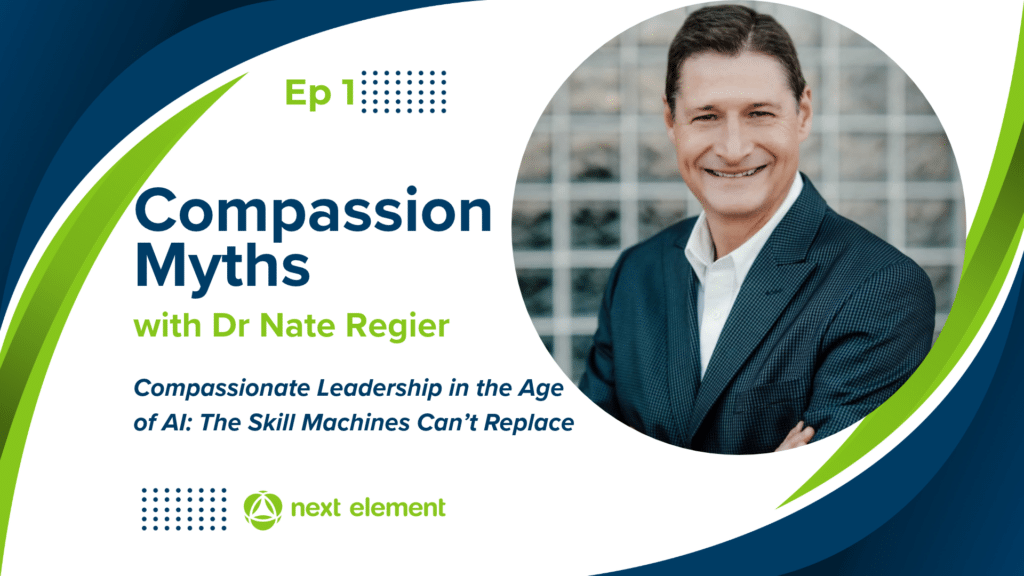
Compassionate Leadership in the Age of AI: The Skill Machines Can’t Replace
Share viaWelcome to the Compassion Myths series with your host, Dr Nate Regier, CEO and Co-founder of Next Element Consulting.
Compassion is one of the most misunderstood leadership competencies. It’s time to challenge the myths!
In this introductory episode, Nate explores why Compassionate Accountability® is becoming more important than ever, particularly as AI transforms the workplace and leaders navigate an increasingly complex world of constant change.
What makes compassion uniquely human? Why does it matter for building trust, strengthening relationships, and achieving meaningful results? And what’s stopping more leaders from embracing it?
Over the next five episodes, Nate will challenge five common myths about compassion, revealing why real compassion isn’t about being soft, rescuing others, or avoiding accountability. It’s about recognizing that people are valuable, capable, and responsible, and learning to struggle with people rather than against them.
Five myths. Five powerful truths. A new perspective on compassionate leadership.
Join us as we challenge conventional thinking and explore why compassion isn’t simply a nice-to-have. It’s an essential leadership competency for the future.
Watch Episode 1
Read the Transcript
Nate Regier: Compassionate Accountability® is the practice of demonstrating that people are valuable, capable, and responsible in every interaction. It’s about recognizing and embracing the tension between building relationships and meeting ever-increasing standards of performance.
Compassionate Accountability sees the relationship as the primary vehicle for accountability and performance.
As AI takes on more of the technical work, Compassionate Accountability is becoming one of the most important leadership competencies an organization can build.
Almost every competency conversation I’m part of these days includes a new line about AI. Fair enough. But here’s a question I keep asking talent and L&D leaders who are planning for what’s next:
When machines can do more of what your leaders do, what’s left that only humans can and should do?
The second question is about change. Now that the time between releases of increasingly powerful models is measured in weeks, how will your leaders navigate constant change, both for themselves and for those they lead?
Can AI show compassion?
It depends on how you define compassion.
The popular definition of compassion is empathy in action aimed at relieving suffering.
AI is getting very good at both. It can read emotions in words and tone, and it solves problems all day long without ever getting tired.
If that’s what compassion is, we’re about to automate it.
But that’s not the kind of compassion that matters most for humans. Compassion is so much more than that.
Real compassion is mutual, meaning we’re in this together. Our fates are interdependent, and we all want to help create solutions today that will impact us tomorrow.
Humans want to feel valuable, capable, and responsible.
While AI is exceedingly capable and becoming more competent every day, it doesn’t care about you.
A machine can serve you. It can remind you, and it can guide you. But it can’t struggle with you. It can’t join you in a mutually accountable relationship.
Why does compassion matter for navigating change?
Our recently published Trust and Conflict Study found that rapid change is making trust more fragile and conflict more frequent at the same time.
Leaders who rescue, retreat, or push harder lose trust fast. Leaders who struggle with people build it.
In fact, I can think of three examples from conversations I had with clients just this week. They shared the powerful impact of shifting their leadership approach to one of struggling with people instead of what they were doing before.
So why don’t more leaders lead this way?
We’ve identified five myths about compassion that keep it stuck in the “nice-to-have” column.
- Compassion is just for bleeding hearts.
- Compassion creates dependence.
- Compassion is soft.
- Compassion is selfless.
- Compassion can’t be learned.
Over the next five posts, I’ll break down each myth and show what it costs leaders in an AI world of accelerating change.
Then I’ll explain the truths about real compassion, the kind that will equip leaders and their organizations for what’s ahead.
The skills easiest to automate are losing value. The ones that aren’t are gaining it.
Would you like to go deeper with the award-winning book behind this series?
These five myths were first articulated in my book, Compassionate Accountability: How Leaders Build Connection and Get Results.
This book makes the full case for compassion as a core leadership competency, including the mindset behind the behaviors.
You can pick up your copy on Amazon or many of your favorite sites.
Meanwhile, stay tuned for the next part of the series:
Empathy vs. Compassion: Why Compassionate Leadership Isn’t Just for Bleeding Hearts.
Don’t forget to subscribe to us on YouTube and stay upto date with the latest episodes as they land. You can subscribe here:
https://www.youtube.com/@NextElement1
You can also follow us on LinkedIn and Facebook where we share insights, news and events and stories from our Compassionate Accountability community.
https://www.linkedin.com/company/next-element-consulting-llc
https://www.facebook.com/NextElement
Book Your Next Keynote Speaker

Author and Co-founder of Next Element, Dr. Nate Regier is available to speak at your upcoming event.
Submit a Speaker RequestPodcast: Listen to Nate "On Compassion"
 Listen to the Podcast
0 Comments
Add comment