

Drama Resilience In the Learning and Development Industry
Share viaWe’ve been tracking Drama Resilience in the Learning and Development industry for over a decade and noticed an interesting trend this year at the Association for Talent Development (ATD) International Conference and Expo in Los Angeles.
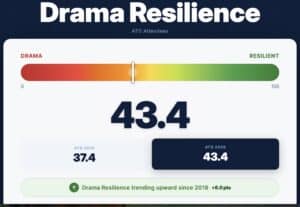
Drama Resilience among attendees at this conference is trending upward since 2016, but it’s still in the danger zone.
What is Drama Resilience?
Conflict is an inevitable outcome of the fact that humans are different, and we care deeply about things. But drama is optional.
Drama is the misuse of conflict in ways that move energy away from relationships and results. Blaming, gossip, avoidance, passive-aggressive behavior, overcontrolling…and the list goes on.
Drama Resilience is the ability of you, your team, or your organization to resist the pull of drama and respond to conflict in productive, constructive ways that build trust, collaboration, and accountability.
How Do You Measure Drama Resilience?
We’ve developed a scientifically validated assessment that measures the frequency of productive and unproductive behaviors during conflict and under pressure. Learn more here about how we do it. Think of it like the Energy Star Rating for your organization. Imagine being able to see where conflict energy is going!
For a quick measure of a person’s Drama Resilience, we selected six of the most powerful items from our 27-item validated assessment to create a short signal survey and invited participants at ATD to try it out for themselves.
Want to try it yourself? Click here.
What Do The Numbers Mean?
The image above is the final tally from ATD after several hundred people had taken the survey. People from all over the world, all kinds of industries, with one thing in common – they are all in the L&D space. In 2016, Drama Resilience in this industry was 37.4. Today it’s 43.4 – a six-point increase.
Drama Resilience can range anywhere from 0-100. Zero is full-on drama! This means that a person (or team, or organization) is responding to conflict with unproductive drama behaviors all the time. The other end of the scale, 100, represents maximum Drama Resilience, responding to conflict productively all of the time.
The scale can be split into four zones.
0-25: Languishing Zone: Drama is all-consuming.
25-50: Danger Zone: Drama is prevalent enough to pose a serious threat to morale, productivity, trust, and engagement.
51-75: Growth Zone: Drama is being replaced by Compassionate Accountability®. There are signs of progress, and more often than not, conflict is a catalyst instead of a threat.
76-100: Flourishing Zone: Drama is being pushed out of the picture. The energy of conflict is consistently being used productively to drive trust, collaboration, and performance. Conflict is one of your greatest assets. Many companies in this zone have begun implementing an SOP for conflict, such as ORPO, because it is too consequential to leave up to chance.
Why Is L&D Still In The Danger Zone?
We’ve been immersed in this industry for 20 years, and we’ve talked with thousands of L&D professionals over the years. Here’s what we’ve observed.
- Solution-Orientation Can Lead to Rescuing: L&D is heavily focused on solutions. Being a solution-provider, who is supposed to have the answers, often works against learner empowerment. Rescuing is one of the three risk factors for drama, which is when we position ourselves as the solution, and spend more time giving advice and spoon-feeding solutions than truly empowering learners to explore, fail forward, and own the learning journey.
- People Skills are Still Lagging: We’ve come a long way in recognizing the importance of social-emotional intelligence, but are L&D professionals keeping up? Two mistakes learning leaders often make are either compromising clarity to keep the peace and make everyone happy, or compromising psychological safety in pursuit of hardline goals. Compassionate Accountability rejects the false choice between relationships and results, and embraces constructive conflict to create more dynamic and engaging learning environments.
- Conflict Capability Gap: We’ve been certifying L&D professionals in our Compassionate Accountability framework for many years, and we consistently see a gap in productive conflict skills. During certification, we begin to work on this gap, and over time, they improve their own skills as they teach others how to do it.
- Mindset Matters: When we discovered The Compassion Mindset®, we realized quickly how powerful it was as a self-evaluation for L&D professionals. The Mindset holds that people are valuable, capable, and responsible. As a learning leader, do you treat yourself and your learners as valuable, capable, and responsible in every interaction? I wrote an article for TD magazine about how this mindset can improve learning outcomes. It starts with the person in the mirror.
- Drama Sells: Drama is seductive and addictive. Everywhere we look, drama is being used to get our attention, suck us in, and drive engagement. So it’s an uphill battle to separate the signal from the noise. L&D leaders are working in environments with more change, more conflict, more stress than ever before. Our struggle is real.
Is AI Drama Resilient?
AI doesn’t care. It just executes and learns. But do your AI-assisted learning programs treat learners as valuable, capable, and responsible? How is conflict handled? Here’s an article exploring compassion in an age of AI.
Although our industry is making some progress, we have a long way to go. Conflict is everywhere, and we have a choice on whether to harness that energy positively or allow drama to derail and distract us from doing our job and delivering high-quality results.
Copyright Next Element Consulting, LLC 2026
Assess Your Team's Drama Resilience
Book Your Next Keynote Speaker

Author and Co-founder of Next Element, Dr. Nate Regier is available to speak at your upcoming event.
Submit a Speaker RequestPodcast: Listen to Nate "On Compassion"
 Listen to the Podcast
0 Comments
Add comment